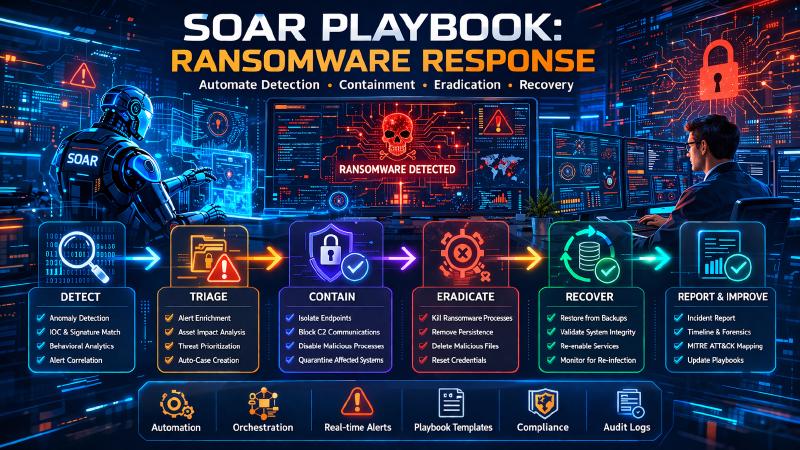
Overview
Ransomware incidents demand the fastest, most disciplined response of any security event. Every minute of delay allows encryption to spread further, backup systems to be targeted, and recovery costs to compound. This playbook automates the containment decisions that must happen in the first five minutes — before a human analyst can even open a ticket.
The playbook covers:
- Automatic isolation of affected endpoints
- Scope determination (is this one machine or an active campaign?)
- Backup integrity verification
- Communication workflows to IT, management, and legal
- Recovery orchestration
Detection Sources (Triggers)
The playbook fires from any of the following:
| Source |
Signal |
| EDR (CrowdStrike / SentinelOne) |
Ransomware behavioural detection, shadow copy deletion, mass file rename |
| SIEM |
High volume file extension changes (.locked, .enc, .crypt) on file servers |
| Endpoint |
vssadmin delete shadows or wmic shadowcopy delete process execution |
| User report |
Ransom note discovered and reported to helpdesk |
Decision Tree
 1
 2
 3
 4
 5
 6
 7
 8
 9
10
11
12
13
14
15
16
17
18
19
20
21
22
23
24
25
26
27
28
29
30
31
32
|
Ransomware Alert Triggered
          │
          ▼
  Is this a true positive?
  (EDR confidence ≥ HIGH or
   ransom note confirmed?)
          │
     YES  │  NO
          │   └──► Escalate to analyst for review
          ▼
  How many endpoints affected?
          │
    ┌─────┴──────┐
  1–3            4+
  hosts          hosts
    │              │
    ▼              ▼
Isolate         Initiate
silently        Crisis Bridge
                Notify CISO
                    │
                    ▼
         Isolate all affected hosts
         Block lateral movement (network segmentation)
                    │
          ┌─────────┴──────────┐
       Backups              Backups
       intact?              compromised?
          │                      │
          ▼                      ▼
    Begin recovery          Engage DR plan
    from clean backup       Notify legal/insurance
|
Step-by-Step Logic
Step 1 — Validate the Alert
 1
 2
 3
 4
 5
 6
 7
 8
 9
10
11
12
13
14
15
16
17
18
19
20
21
22
23
24
25
26
27
|
def validate_ransomware_alert(alert):
    confidence_score = 0

    # EDR detection from a known ransomware family
    if alert.edr_classification in KNOWN_RANSOMWARE_FAMILIES:
        confidence_score += 50

    # Shadow copy deletion — near-certain ransomware indicator
    if alert.process_cmdline and any(cmd in alert.process_cmdline for cmd in [
        'vssadmin delete shadows',
        'wmic shadowcopy delete',
        'bcdedit /set recoveryenabled no'
    ]):
        confidence_score += 40

    # Mass file rename (>100 files with new extension in 60 seconds)
    if alert.file_rename_count > 100:
        confidence_score += 30

    # Ransom note file created
    if alert.file_created and any(
        note in alert.file_created.lower()
        for note in ['readme', 'decrypt', 'how_to', 'ransom', 'restore_files']
    ):
        confidence_score += 30

    return confidence_score >= 50, confidence_score
|
Step 2 — Isolate Affected Endpoints
 1
 2
 3
 4
 5
 6
 7
 8
 9
10
11
12
13
14
15
16
17
18
19
20
21
22
23
24
25
26
27
28
29
30
31
32
33
34
35
36
37
38
39
|
def isolate_endpoints(affected_hosts, edr_client):
    isolation_results = []

    for host in affected_hosts:
        try:
            # CrowdStrike network containment
            result = edr_client.contain_host(device_id=host.device_id)
            isolation_results.append({
                'hostname': host.hostname,
                'status': 'ISOLATED',
                'timestamp': datetime.utcnow().isoformat(),
                'method': 'EDR network containment'
            })
        except Exception as e:
            # Fallback: firewall-level block
            firewall_block_host(host.ip_address)
            isolation_results.append({
                'hostname': host.hostname,
                'status': 'ISOLATED_FALLBACK',
                'method': 'Firewall ACL'
            })

    return isolation_results

def assess_blast_radius(initial_host, siem_client, lookback_minutes=30):
    """Find other hosts that communicated with the affected host
       in the window before detection."""
    query = f"""
    index=network_traffic
    (src_ip="{initial_host.ip}" OR dest_ip="{initial_host.ip}")
    earliest=-{lookback_minutes}m
    | stats values(src_ip) as sources, values(dest_ip) as destinations by _time
    """
    results = siem_client.search(query)
    lateral_candidates = set()
    for r in results:
        lateral_candidates.update(r['sources'] + r['destinations'])
    lateral_candidates.discard(initial_host.ip)
    return list(lateral_candidates)
|
Step 3 — Identify the Ransomware Family
 1
 2
 3
 4
 5
 6
 7
 8
 9
10
11
12
13
14
15
16
17
18
19
20
21
22
23
24
25
|
import hashlib
import requests

def identify_ransomware_family(ransom_note_text, encrypted_file_extension):
    """
    Query ID Ransomware (public API) to identify the family
    from the ransom note or encrypted file extension.
    """
    # Check extension against known families database
    known_extensions = {
        '.lockbit': 'LockBit',
        '.blackcat': 'BlackCat/ALPHV',
        '.hive':    'Hive',
        '.phobos':  'Phobos',
        '.dharma':  'Dharma/CrySis',
        '.ryuk':    'Ryuk',
    }
    family = known_extensions.get(encrypted_file_extension.lower(), 'Unknown')

    # Cross-reference with VirusTotal if we have a sample hash
    return {
        'family': family,
        'extension': encrypted_file_extension,
        'note_preview': ransom_note_text[:200] if ransom_note_text else None
    }
|
Step 4 — Verify Backup Integrity
 1
 2
 3
 4
 5
 6
 7
 8
 9
10
11
12
13
14
15
16
17
18
19
20
21
22
23
24
25
26
27
28
29
30
31
32
33
34
35
36
|
def verify_backup_integrity(affected_systems, backup_client):
    """
    Check whether backups for affected systems exist and
    were last written BEFORE the ransomware activity window.
    """
    backup_status = []

    for system in affected_systems:
        backups = backup_client.get_backups(system.hostname)

        if not backups:
            backup_status.append({
                'system': system.hostname,
                'status': 'NO_BACKUP',
                'action': 'ESCALATE_TO_DR'
            })
            continue

        latest_backup = max(backups, key=lambda b: b.timestamp)
        attack_start = system.first_detection_time

        if latest_backup.timestamp < attack_start:
            backup_status.append({
                'system': system.hostname,
                'status': 'CLEAN_BACKUP_AVAILABLE',
                'backup_time': latest_backup.timestamp.isoformat(),
                'action': 'PROCEED_WITH_RECOVERY'
            })
        else:
            backup_status.append({
                'system': system.hostname,
                'status': 'BACKUP_POTENTIALLY_ENCRYPTED',
                'action': 'MANUAL_VERIFICATION_REQUIRED'
            })

    return backup_status
|
Step 5 — Notify Stakeholders
 1
 2
 3
 4
 5
 6
 7
 8
 9
10
11
12
13
14
15
16
17
18
19
20
21
22
23
24
25
26
27
28
29
30
31
32
|
def notify_stakeholders(incident, scope, family_info, backup_status):
    severity = 'P1' if scope['hosts_affected'] >= 4 else 'P2'

    # SOC channel
    teams_post_to_channel(
        channel='#soc-alerts',
        title=f"[{severity}] RANSOMWARE INCIDENT — {incident.id}",
        body=f"""
**Family:** {family_info['family']}
**Hosts isolated:** {len(scope['isolated_hosts'])}
**Backup status:** {sum(1 for b in backup_status if b['status'] == 'CLEAN_BACKUP_AVAILABLE')} clean / {len(backup_status)} total
**Extension:** {family_info['extension']}
        """
    )

    # For P1, also notify CISO and IT manager via email
    if severity == 'P1':
        send_email(
            to=['ciso@company.ae', 'it-manager@company.ae'],
            subject=f"[URGENT] Active Ransomware Incident — {scope['hosts_affected']} systems affected",
            body=build_executive_summary(incident, scope, family_info)
        )

    # Create P1 incident ticket
    ticket = servicenow_create_incident(
        priority=1,
        category='Ransomware',
        short_desc=f"Ransomware: {family_info['family']} — {scope['hosts_affected']} hosts",
        description=build_full_report(incident, scope, family_info, backup_status)
    )

    return ticket
|
Step 6 — Block Known IOCs
 1
 2
 3
 4
 5
 6
 7
 8
 9
10
11
12
13
14
15
16
17
18
19
20
|
def block_ransomware_iocs(family_info, firewall_client, proxy_client):
    """
    Pull known C2 IPs and domains for the identified family from MISP
    and block them at the perimeter immediately.
    """
    if family_info['family'] == 'Unknown':
        return []

    iocs = misp_search_by_tag(f'ransomware:{family_info["family"].lower()}')
    blocked = []

    for ioc in iocs:
        if ioc['type'] == 'ip-dst':
            firewall_client.block_ip(ioc['value'], comment=f"Ransomware C2 — {family_info['family']}")
            blocked.append(ioc['value'])
        elif ioc['type'] == 'domain':
            proxy_client.block_domain(ioc['value'])
            blocked.append(ioc['value'])

    return blocked
|
Recovery Checklist (Post-Containment)
Once the incident is contained, the playbook generates a structured recovery checklist assigned to the IT team:
1
2
3
4
5
6
7
8
9
|
□ Verify all affected hosts are isolated from the network
□ Confirm backup integrity for each affected system
□ Rebuild affected systems from clean image (do not decrypt in place)
□ Restore data from last clean backup
□ Reset credentials for all accounts active on affected systems
□ Rotate service account passwords for systems in blast radius
□ Patch the initial access vector before reconnecting to network
□ Enable additional monitoring on rebuilt systems for 30 days
□ Conduct post-incident review within 72 hours
|
ATT&CK Coverage
| Tactic |
Technique |
Playbook Action |
| Execution |
T1059 — Command & Scripting |
Block process execution, alert on shadow copy commands |
| Defense Evasion |
T1490 — Inhibit System Recovery |
Trigger immediate isolation |
| Impact |
T1486 — Data Encrypted for Impact |
Core detection trigger |
| Lateral Movement |
T1021 — Remote Services |
Scope assessment, segment network |
Contact me at contact@malsayegh.ae to discuss ransomware preparedness or playbook adaptation.